
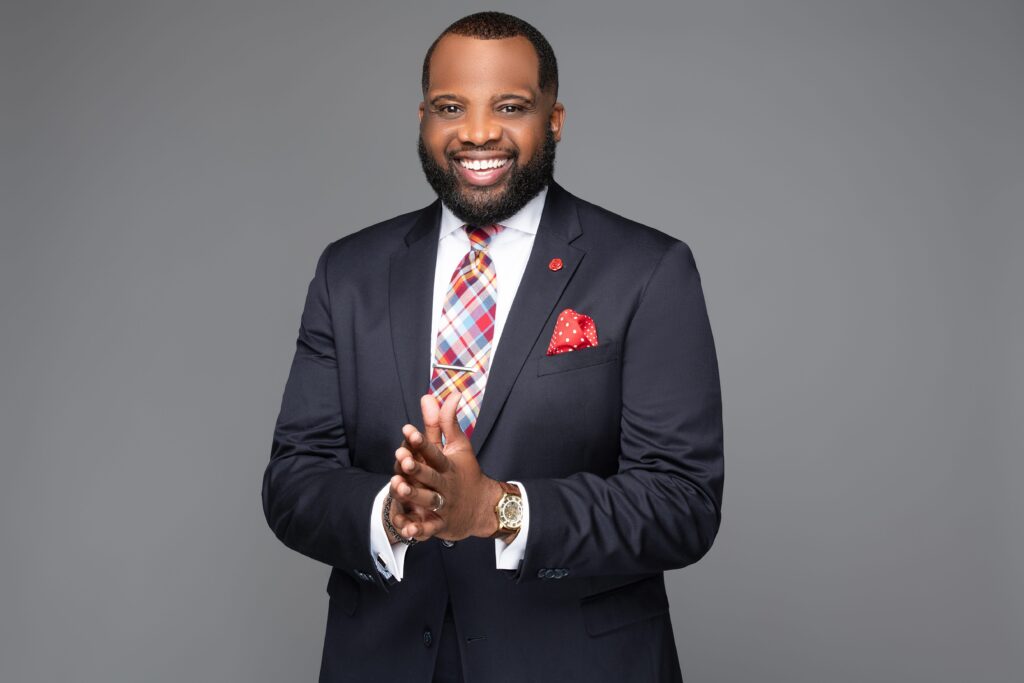
Dr. Scott H. Moats’ selection as Anderson University’s sixth president marked a watershed moment not just for the university, but also for its long-standing relationship with the Church of God. Among the prominent participants at Moat’s inauguration last month was Rev. Monté L. G. Dillard, Sr., interim general director of Church of God Ministries, who conveyed greetings on behalf of the movement and voiced faith in the university’s future.
In a follow-up interview, Dillard discussed the significance of the event, the historical and spiritual bonds of the AU-Church of God collaboration, and the problems and opportunities confronting Christian higher education today.
A Personally Significant Inauguration
Dillard viewed his involvement in the inauguration as highly meaningful.
“It was my first presidential inauguration since becoming interim director, which I thought was really powerful,” he recalled. “Our entire movement—in various leadership roles—seemed to be transforming.
He noted that it is rare for major leadership transitions within both the Church of God Ministries and the university to coincide.
“Those timelines don’t usually run parallel,” he said. “It was a blessing to step into leadership at the same time the flagship school of our movement welcomed new leadership.”
Dillard underlined the solid professional relationship he and Moats developed early on. Their first significant meeting had taken place months earlier, at the Church of God Convention in Denver.
“From that time to now, President Moats has been gracious and intentional,” he said. “We have worked to get to know each other and build a foundation for partnership.”
A Central Message: “The Church of God Is Alive”
During the inauguration ceremony, Dillard’s greeting focused on a message he believes is crucial at this point in the movement’s history.
“The Church of God is alive,” he announced. “God’s Spirit is with us, and there is tremendous potential ahead.”
He was enthusiastic about Moats’ “rise up and build” concept.
“I believe the Lord gave that message to him,” Dillard stated. “We at Church of God Ministries are excited to see him step into leadership at Anderson University.”
A Movement, Not a Denomination
Dillard’s statements emphasized the Church of God’s status as a holiness movement rather than a denomination, which he says reflects a spiritual posture of receptivity.
“We have always identified ourselves as a movement,” he explained. “A movement follows the Spirit’s guidance. If the Spirit says to move, we do.”
He further stated that this identity carries expectations for leaders throughout the movement.
“We are firmly positioned at this time to have important leaders in key spots who can help us sense what God is saying and lead us in that direction.”
A Renewed and Intentional Partnership
Anderson University and the Church of God have had a relationship for over 108 years, but Dillard believes it is entering a new phase.
“There is new energy and a renewed intentionality about deepening the relationship,” he said. “Some might call it re-engagement, but it is truly about becoming what we were always meant to be together.”
He emphasized that the partnership is more than just administrative.
“We aren’t just collaborating. We are collaborating in a way that is extremely specific to who we are as a movement.”
Dillard emphasized the university’s historical significance as the “flagship school” of the Church of God.
“The success of Church of God Ministries is intertwined with the success of Anderson University,” he stated. “And Anderson’s future should absolutely include a deep partnership with the movement.”
Values of Unity, Holiness, and Service: Lived Out on Campus
The Church of God has long promoted unity, holiness, and service, which Dillard says he frequently sees on the AU campus, particularly through its leadership.
“I visit the university frequently,” he stated. “There is a great sense that these three components are at the forefront. In my interactions with them, I have seen togetherness, holiness, and service vividly demonstrated. These values determine the university’s orientation.”
Why the General Assembly Still Ratifies Trustees and Presidents
Many members of the campus community are unaware that the Church of God General Assembly continues to ratify the AU’s campus’s Board of Trustess and president legally. Dillard said that this procedure ensures alignment between the university and the movement.
“This has always been part of our governance model,” he told me. “It ensures that the leadership of Anderson University reflects the heart and convictions of the movement.”
He emphasized that the ratification process is centered on the mission rather than control.
“It makes no difference whether a candidate has grown up in the Church of God or not. “What matters is alignment,” he explained. “President Moats is newer to the movement, but it was clear that his beliefs, values, and vision aligned with who we are.”
A Faithful Campus in the Church of God Tradition
When asked what constitutes a “faithful campus,” Dillard proposed a structure based on both adaptation and theological consistency.
“As time changes and methods evolve, we should address how we do things,” he told me. “But the message is ancient and unchanging.”
Dillard emphasized that a loyal campus is rooted in Scripture and focused on Christ.
“It must uphold the values, scriptural positions, and heart of Jesus on all matters,” according to him. “If we lose the heart of the gospel, nothing else we build will matter.”
Higher Education, Cultural Tension, and Holding Conviction
Higher education institutions are under increasing financial pressure, cultural shifts, and arguments about the role of faith in academic settings. Dillard argues that institutions such as AU must prepare for unavoidable conflict.
“To stand for Christ in an ever-changing culture often means facing conflict,” he told reporters. “We must expect it.”
He used Scripture to emphasize his point.
“Christ never sinned—and they still killed Him,” he stated. “If he could not avoid conflict, we certainly will not.”
Dillard believes that friction is something to be embraced rather than avoided.
“We should not be paralyzed trying to avoid conflict,” he told me. “We must do what is right, in the right spirit, regardless.”
The Church of God’s Role in Supporting Its Universities
Dillard believes that the Church of God must actively support its four affiliated universities – AU, MId-America Christian University, Warner University, and Warner Pacific University – both spiritually and practically.
“We must affirm biblical convictions and leverage every opportunity to help shape students,” he told me.
He expressed concern that some leaders avoid having difficult conversations with younger generations.
“The culture does not hesitate to influence them,” he told me. “We cannot withhold truth when the world is giving them constant messages.”
He emphasized that Christian formation and intellectual progress should be integrated.
“The classroom is not separate from discipleship,” he told me. “We must make full use of this opportunity.”
Characteristics of Effective Faith-Based Leadership
Dillard identified three essential qualities for leaders in today’s Christian institutions:
- Deep conviction.
“Leaders must not waver,” he said. “Leadership carries influence, and conviction must hold under pressure.” - Strong, Spirit-filled community.
“One person can be overcome; two can stand back-to-back.” - Focused stewardship.
“There is always more to do than one person can accomplish,” he said. “Leaders must cover their zone and trust God to raise others for the rest.”
Defining Moments in a Shared 108-Year History
Reflecting on the long relationship between AU and the Church of God, Dillard highlighted two defining historical elements:
- Camp Meeting
For decades, the annual gathering of the Church of God was held on the grounds of Anderson University, drawing thousands.
“It was the hub of our movement,” Dillard said. “It shaped our fellowship and identity.” - Church of God Ministries headquarters on campus
For many years, the movement’s headquarters operated from the old Warner Press building.
“Moving off campus was difficult,” he said. “But the shared history remains significant.”
A Season of Alignment and Opportunity
As Anderson University begins a new chapter under President Moats’ leadership, Rev. Dillard expressed confidence that the university’s and the Church of God’s mission and vision are both timely and Spirit-led.
“We are in a season where God is raising leaders in key places,” the pastor remarked. “Anderson University is poised for something special.”
With renewed partnership, shared heritage, and mutual commitment to unity, holiness, and service, both institutions appear ready to step into their next chapter.