
Christopher Blezek, a senior majoring in national security, political science, and history was in Warsaw, Poland from late February to June of last year as part of a study abroad program. As he was there, and even after the program ended, he took it upon himself to visit several countries, including but not limited to Hungary, Italy, Germany, Ukraine, Turkey, Lebanon, Syria, and Saudi Arabia. Blezek made many of these visits with little to no preparation beforehand, catching flights or lifts from truck drivers on a whim or using the train station right next to his apartment. His trip to Kyiv, Ukraine, Blezek mentioned, was decided upon merely four hours in advance.
While he was in Ukraine, Blezek could see guard shacks and ruins from the ongoing war with Russia, and he had to download an app on his phone that warned of missiles or drone swarms, but otherwise everything was “strangely normal.” When asked about what it was like there, he said, “After three years of going through this war, people just kind of go about it…everybody’s in normal dress, everybody’s still going out to eat.” There was one instance when he was in his hotel room and saw two flares from outside his window just before the air raid sirens started. A voice on the loudspeaker, in both English and Ukrainian, informed the people in the building to make their way to the shelter, which was simply a room beside the kitchen that had been cleared out. Blezek opted to stay in his hotel room, commenting, “Well, if I’m gonna die, I’m gonna die either way…I’d rather die with some sleep.” The air raid lasted for 24 hours, and it was, at that point in the war, the largest one that had happened in Kyiv. Blezek left shortly after.
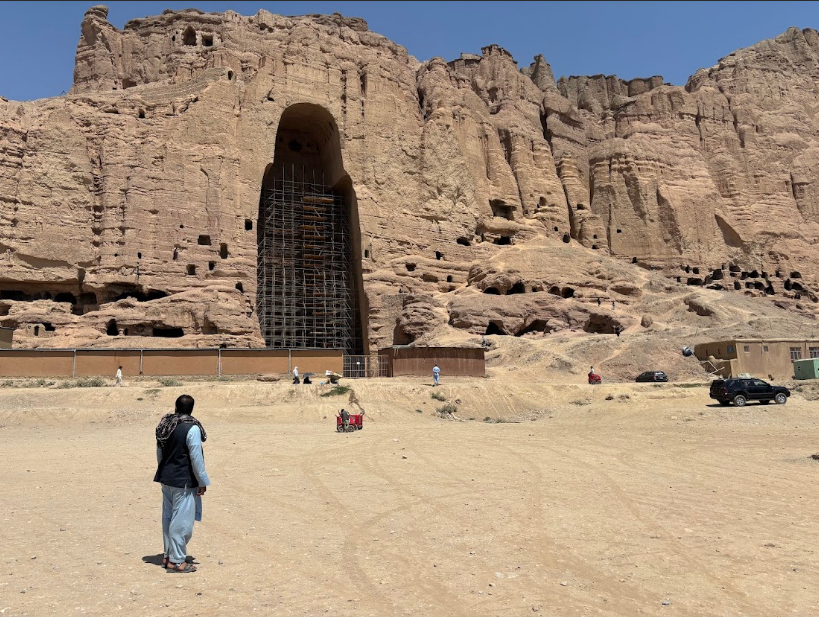
Kyiv was not the only place where Blezek experienced danger, though the other two instances of it were not ones he would have expected. While in Syria, Blezek ran into two men who noticed he was an American and wanted to take photos with him. One of the men tried to hail a cab, but he was holding his rifle improperly, swinging it around as he stood between Blezek and the other man. When recounting this event, Blezek said he was thinking, “Dude, if I’m gonna die in Syria, I don’t want my story to be that I got shot because you don’t know what muzzle discipline is.” Blezek also had the opportunity to visit the remains of the massive statues of Buddha located in Bamiyan, Afghanistan. Though the statues were destroyed by the Taliban in 2001, the valley is still a UNESCO World Heritage site. Blezek noted he wasn’t really supposed to have access to the site, but there were three Taliban guards keeping watch over visitors, ensuring nothing was stolen. One of these guards unlocked a gate to lead Blezek up a set of winding, thousand year-old stairs, to the top of where one of the statues used to be, before promptly demanding money. Blezek handed him five hundred Afghan, around seven dollars in U.S. currency, stating, “Okay, I should probably pay you so you don’t throw me off the giant cliff.” He stated that his professor loves to say he bribed the Taliban, but he prefers to label the situation as poor extortion.
But for each of the more lighthearted moments of his travels, there were other– bleaker– sights that stuck in Blezek’s memory. As he was being driven around Afghanistan, which was described to him by an inhabitant as “the living ruling the dead,” the car would stop outside of a gas station or a restaurant and would quickly be swarmed by dozens of hungry children that all pressed against the car and begged for food. Blezek said he gave the children about ten Afghan, which is roughly a dime in U.S. currency, and that the children were incredibly thankful to simply have something to eat. In Syria, there was a park outside of Blezek’s hotel where at least 100 people would sleep in any place they could find. When asked for any insights he had, Blezek responded, “What I’d say about Syria is that there’s not a lot of hope from anybody there. Everybody kind of has this viewpoint that the future of Syria is bleak, and if anything’s going to change in your future, it’s probably gonna be for the worse.”
Blezek had another insight, however, one that covered the entirety of his journeys, both the disturbing and the intriguing.
Humans are capable of both equal cruelty and kindness. I met people who were equally kind and people that were equally cruel, in all parts of the world
Christopher Blezek
When asked whether or not he recommends other students to follow in his footsteps, Blezek spoke in favor of studying abroad, claiming that it shatters the idea of an American-centric viewpoint, allows one to really learn about other cultures and avoid the pitfall of lumping several peoples into just saying the Middle East, and is in general a beneficial way to expand one’s own understanding of the world. “I recommend people learn more about the world. I recommend people take the time to understand,” Blezek stated. “I mean, the world’s a large place, to put it bluntly. And relying on other people without developing your own understanding is a very foolish idea.” However, Blezek did emphasize that he cannot exactly recommend nor discourage someone traveling spontaneously as he did to countries in the middle of war and/or revolution. “Do so at your own risk. I probably simply lack a self preservation instinct… I’m not the kind of person that did a lot of stupid stuff in high school, but then I ran off to the Middle East. That’s my vice, I guess.”