
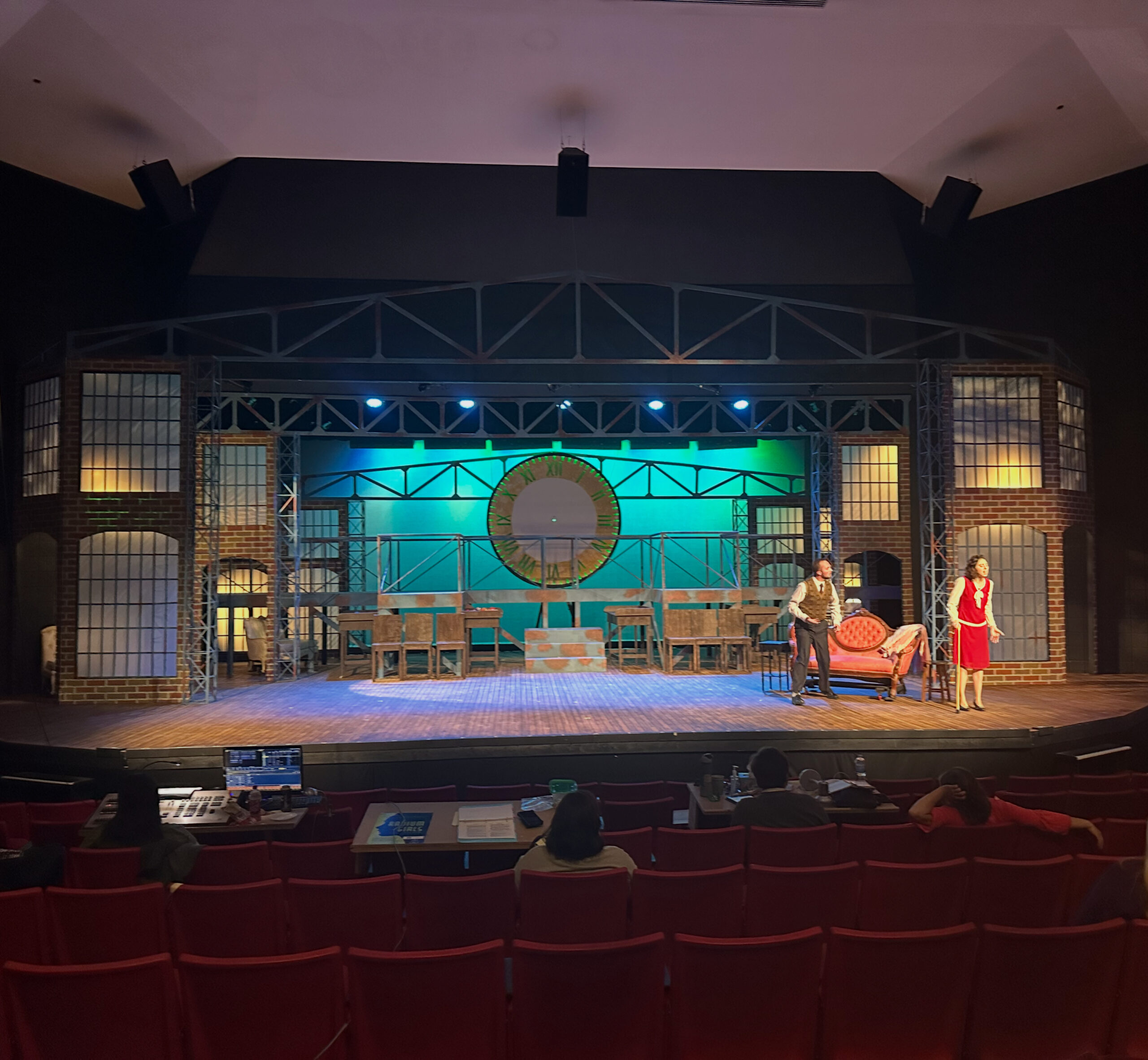
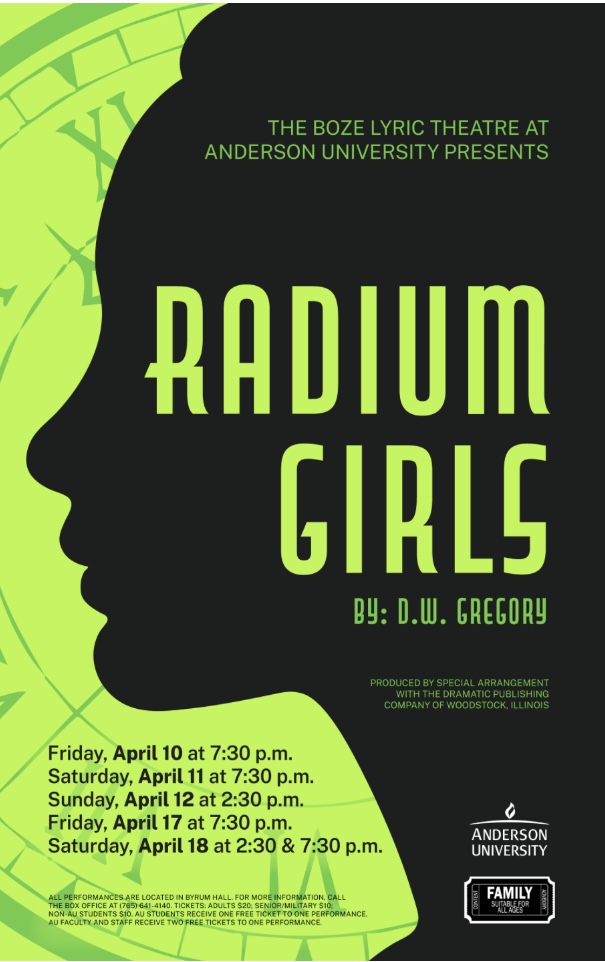
The School of Music and Performing Arts’ mainstage production for the spring, Radium Girls, opens this weekend in Byrum Hall. Written by award-winning playwright D.W. Gregory, the play follows the true case of Grace Fryer, a dial painter who sued the United States Radium Corporation after she and the other women painting radium dials for clocks experienced radiation poisoning. With just thirteen people in the cast portraying over thirty characters, the production promises to be an intimate and introspective experience unlike the many other productions of the play that have been done— especially with the addition of the Greek chorus.
The director of the play, Caroline Sanchez, decided to add the Greek chorus into the production as a way to represent the Radium Girls that are mentioned but never seen on the stage themselves, as well as to highlight a key theme of the story. “We see that they aren’t allowed to speak their truths and that we have to rely on the people that come after us sometimes to defend us,” she said. She also noted that in the 1920s, which is the time period in which the play is set, there was a resurgence of fascination with Greek life and culture. Incorporating that aspect of the time not only adds an air of authenticity to the production but also portrays a key idea that is relevant not only to the play’s world but to the current one as well, the idea that history exists in a pattern. “I think we’re seeing now nearly a hundred years later, things repeat often,” Sanchez said. “And so we have to continue to study history so we don’t repeat our mistakes.”
With the source material being written around real people and events, there was an extensive amount of research that went into the rehearsal process for Radium Girls. Senior Harmon Hann, the assistant director, mentioned reading through the actual documents of the case, of which there are over three hundred in the National Archives. He also mentioned analyzing the historical context of the show, really looking into what U.S. society looked like during this time, such as who the president was and whether or not the country was at war. This sort of context is crucial to understanding the significance of the case and the women who led it. As Michele Mullins, who is in charge of props and caring for the costumes, put it, “I think, even though the story is a hundred years old, it is still incredibly relevant today. And one thing to keep in mind is in the 20s, women did not work outside the home. They were moms, they were homemakers, and this group of women were really leading the way and changing the future.”
The story of the Radium Girls has been told in various formats— through legal cases, literature, and film— but the presentation of the play adds an entirely new element that is significant to the emotional core of the production. As Sanchez explained, “When you have the personal connection of watching a play, you have a visceral reaction to the content.” Radium Girls in particular delivers that strong personal aspect, which was noted by Grace Stark, a senior majoring in psychology and youth leadership development and the actress for Grace Fryer, who compared the experience of Radium Girls to 2024’s fall production, Murder on the Orient Express. “The difference is the emotional value,” she said. “I think in Murder, you really got a similar emotional value towards the end, but this has that really deep emotional value throughout the whole show.” Harmon also discussed the emotional value of the play and the ways in which that can resonate with audiences. “Especially with the elements of grief and family relationships that are slowly intertwined in the show, it really hits home,” he said. “Not just for everyone’s personal safety, but as caretakers and loved ones.”
Those who plan on attending Radium Girls should be advised that the production will contain black lights, high-pitched sounds and a fair amount of blood. The show will run Friday, April 10 and Saturday, April 11 at 7:30 p.m., as well as Sunday, April 12 at 2:30 p.m. for the first weekend. The next weekend will run Friday, April 17 at 7:30 p.m. and twice on Saturday, April 18, with showings at 2:30 and 7:30 p.m. Students of Anderson University may claim one free ticket. Tickets are ten dollars for non-AU students or twenty dollars for adults. The Boze Lyric Theatre box office can be reached at (765) 641-4140 for further questions or assistance.